Steampunk House Backgrounds for Covers 5: A Designer's Guide
There’s a specific challenge every designer, author, and content creator faces when trying to stand out in a crowded digital marketplace. Generic stock photos often fail to capture the unique personality of a project, especially when that project demands a touch of vintage sophistication or industrial fantasy. This is where Steampunk House Backgrounds for Covers 5 steps in, offering a solution that goes beyond simple decoration. It provides a foundational layer of visual storytelling, transforming standard layouts into immersive environments rich with gears, brass textures, and Victorian-era architecture.
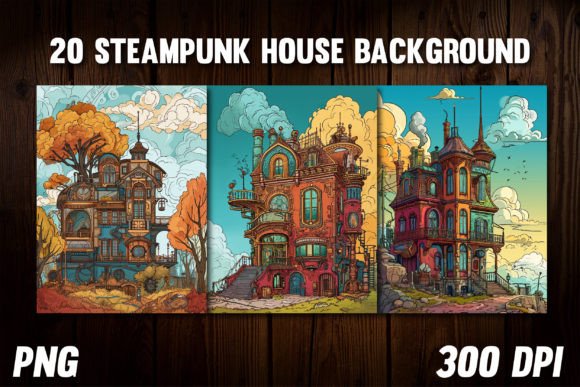
As a creative professional, you understand that the background is not just empty space; it is the stage upon which your content performs. A poorly chosen backdrop can dilute your message, while a meticulously crafted one elevates the entire composition. This collection focuses on the architectural elements of the Steampunk genre—towering clockwork structures, intricate Victorian facades, and the seamless blend of nature and machinery. It is designed for those who need to convey a sense of depth, history, and imagination in their work.
Understanding the Visual Personality
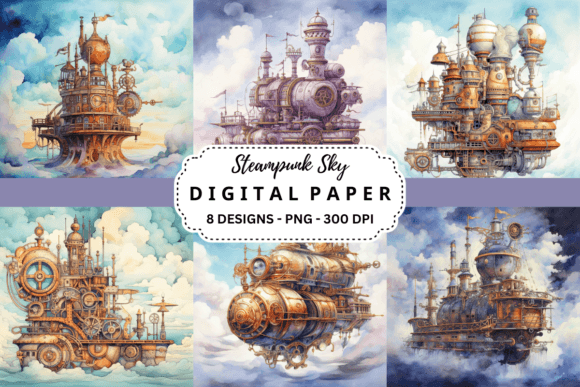
Steampunk is often misunderstood as merely "gears and goggles," but true Steampunk design is rooted in a specific aesthetic philosophy. It combines the elegance of the Victorian era with the raw power of the Industrial Revolution. When you look at the Steampunk House Backgrounds for Covers 5, you will notice a distinct focus on architectural detail. These are not abstract patterns; they are illustrations of environments. The visual personality is characterized by warm, metallic tones—copper, bronze, and oxidized greens—contrasted against deep shadows and rich textures like wood grain and leather.
The style leans heavily into the concept of "retro-futurism." It imagines a world where steam power remained the primary energy source, leading to complex, exposed machinery integrated into everyday life. For a designer, this translates to backgrounds that have a natural "grit." They feel tactile and substantial. This texture is crucial because it adds a layer of professionalism to digital products. When used as a backdrop for a book cover or a website hero image, it immediately signals to the viewer that the content is curated and high-quality. It avoids the sterile, "plastic" look that can sometimes plague modern digital design.
Strategic Applications for Modern Creators
The versatility of this collection is one of its strongest assets. While the niche is specific, the applications are surprisingly broad. For Amazon KDP publishers, particularly those creating coloring books, journals, or planners, these backgrounds serve as excellent cover art or interior chapter dividers. The intricate line work often found in Steampunk illustrations is perfect for coloring books, offering adults a complex and engaging activity.
For brand identity and logo design, these backgrounds can be used to create mockups or social media assets. Imagine a coffee roaster or a craft brewery using these images to showcase their branding. The industrial, artisanal vibe of Steampunk aligns perfectly with brands that want to emphasize craftsmanship and tradition. Similarly, in editorial design, these images can break up long blocks of text in magazines or blogs, providing visual relief that keeps the reader engaged.
Consider the needs of a content creator running a podcast or a YouTube channel about history, science fiction, or DIY crafts. The Steampunk House Backgrounds for Covers 5 can be adapted for thumbnails, channel art, or episode covers. This consistency in visual language helps build brand recognition. When your audience sees that distinct copper-and-gear aesthetic, they immediately associate it with your content, strengthening your brand perception over time.
Integrating Backgrounds into Your Workflow
Working with high-resolution background images requires a practical approach to composition. Because these backgrounds are rich in detail, they function best when paired with clean, legible typography. This is where the interplay between display fonts and sans serif fonts becomes critical. A heavy, ornate serif or a script font might complement the Victorian vibe, but it needs to be used sparingly for headlines to ensure readability. For body text or subheadings, a clean modern typography style—perhaps a geometric sans-serif—provides a necessary contrast that keeps the design from feeling cluttered.
When incorporating these assets into packaging design or web design, consider the hierarchy of information. The background should support the message, not compete with it. You might use the full illustration for a cover, but for a webpage, you might use a cropped section or apply a slight overlay to darken the image, ensuring that white text pops against it. This technique maintains the atmospheric feel of the Steampunk House Backgrounds for Covers 5 while prioritizing user experience.
Evaluating Fit and Technical Quality
Before finalizing a design, it is essential to evaluate how the background interacts with your specific project goals. Not every project suits a complex aesthetic. If your brand identity relies on minimalism and stark whitespace, a dense Steampunk background might create visual noise. However, if your project calls for immersion, storytelling, or a vintage industrial vibe, this collection is an ideal fit.
From a technical standpoint, the value of a premium font or image set lies in its resolution. These backgrounds are provided as high-resolution images, which is vital for print applications. Whether you are printing a large format poster or a standard paperback cover, pixelation is a risk with low-quality assets. The Steampunk House Backgrounds for Covers 5 are designed to maintain their clarity and detail even when scaled, ensuring your final product looks professional.
Another practical consideration is the licensing for commercial use. As a designer or entrepreneur, you need to ensure that your design assets are cleared for the specific ways you intend to use them. This collection is structured to support a wide range of commercial applications, from digital products to physical merchandise. Always review the terms to ensure they align with your distribution plans, particularly if you are creating items for resale, such as planners or wall art.
Conclusion: Elevating Your Creative Narrative
Ultimately, the goal of using specialized assets like the Steampunk House Backgrounds for Covers 5 is to create a cohesive and compelling narrative for your audience. It is about moving beyond generic templates and investing in visuals that tell a story. Whether you are an author looking to entice readers with a mysterious cover, a marketer aiming to capture attention in a busy feed, or a crafter designing a unique gift, these backgrounds provide the texture and depth needed to make a lasting impression.
By treating your background as an integral part of the design rather than an afterthought, you elevate the perceived value of your entire project. The intricate details of gears, brass, and Victorian architecture invite the viewer to look closer, creating an engagement that flat, simple backgrounds often fail to achieve. Explore the possibilities, test the pairings, and let these unique assets anchor your next creative endeavor.